
Join our customer list.
In 2024, the global automated blinds and shades market reached USD 1.99 billion (Persistence Market Research, 2024), and is projected to hit USD 5.30 billion by 2032 at a 13.8% CAGR. Competing estimates from Mordor Intelligence place the 2025 market at USD 2.52 billion and rising to USD 3.84 billion by 2030, while Arizton measured USD 4.02 billion in 2024 with a forecast of USD 5.72 billion by 2030. The variance shows one thing clearly: momentum is undeniable, with growth averaging 6–14% annually across different models
Why does this matter now? Families moving into new homes face decisions that directly affect safety, comfort, and energy bills. Business owners must weigh productivity gains and professional aesthetics. Investors are watching an industry where North America alone accounts for 38.7% of demand (Mordor Intelligence, 2024), and Asia-Pacific shows a projected CAGR of 9.6% through 2030. With automated shades now accounting for 70.65% of all motorized control solutions (Mordor Intelligence, 2024), the tipping point is here.
This guide will deliver three things: (1) clear definitions and technologies explained, (2) room-specific buying strategies backed by real data, and (3) a cost-value breakdown for families, business owners, and investors. By the end, you will know which automated shades to choose for every room, how much energy you can save, and why this market deserves investor attention.
WHAT ARE AUTOMATED SHADES?
Automated shades are window treatments that open and close through motorized systems—controlled by remote, smartphone apps, voice assistants, or environmental sensors. As of 2024, 70.65% of installations were motorized (Mordor Intelligence, 2024). Residential applications dominate with 68.64% share, while B2C retail accounts for 72.54% of sales.
Control options include:
- Battery powered shades—ideal for retrofit projects and homes without wiring.
- Hardwired systems—best for new construction and commercial buildings.
- Hybrid solutions—wired with battery backup, ensuring operation during outages.
Integration capabilities include Amazon Alexa, Google Home, and Apple HomeKit, with top-down/bottom-up designs and solar sensor-linked models that adjust based on sunlight.
MARKET OVERVIEW & TRENDS
As of 2024:
- Market value: USD 1.99 billion (Persistence) / USD 4.02 billion (Arizton).
- Forecast 2030: USD 3.84 billion (Mordor) / USD 5.72 billion (Arizton).
- Forecast 2032: USD 5.30 billion (Persistence).
Regional insights:
- North America: 38.7% share (Mordor, 2024).
- Asia-Pacific: fastest growth, 9.6% CAGR to 2030.
- Europe: trending toward energy-code driven adoption (IECC 2024 compliance).
Investor takeaway: Residential demand is strongest, but commercial applications—especially offices and hospitality—are catching up as energy regulations tighten.
KEY BENEFITS OVERVIEW
- Energy savings: Automated shades can reduce HVAC energy consumption by up to 30% (arXiv, 2023).
- Safety: Cord-free designs eliminate strangulation risks, critical for families with children and pets (Louver Shop Shutters, 2024).
- Property value: Green homes with energy-efficient features sell for 3% more (Window + Door, 2024).
- Well-being: Improved sleep quality, mood, and productivity (Green Builder Media, 2024).
- Accessibility: 1 in 4 US adults lives with a disability (CDC, 2024), making remote-operated shades essential.
ROOM-BY-ROOM RECOMMENDATIONS
Families and businesses should approach each space differently.
Living Room: Large windows benefit from motorized roller shades for light control and glare reduction. Voice-control integration maximizes convenience for social settings.
Bedrooms: Blackout automated shades improve sleep hygiene. Up to 63% of Americans report sleep disruption from light exposure (CDC, 2024).
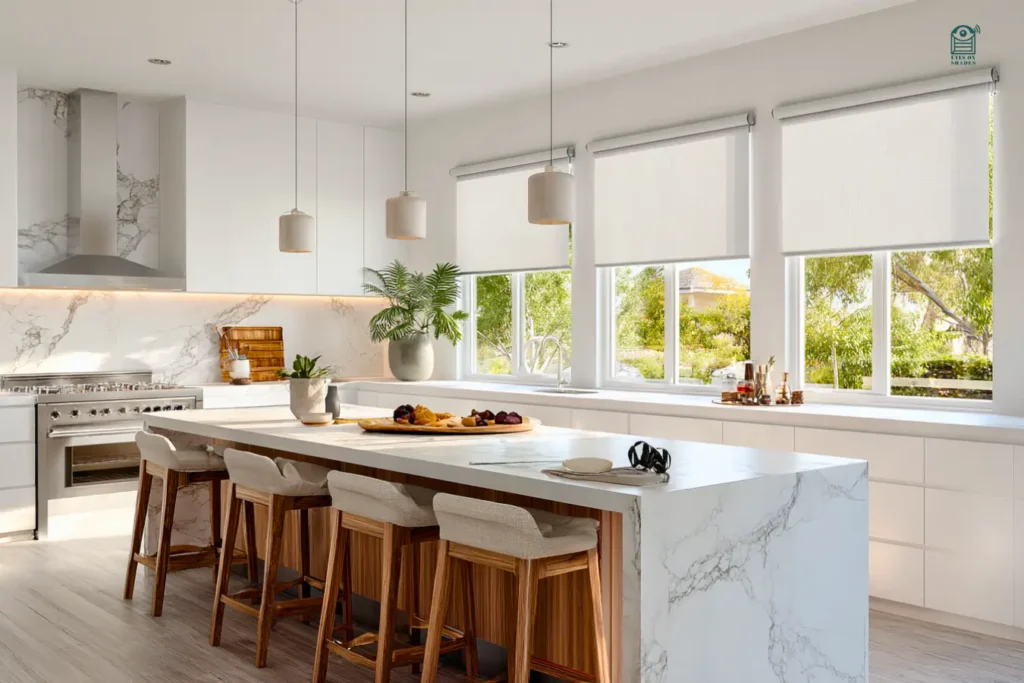
Kitchen: Top-down/bottom-up styles provide privacy while allowing daylight. Battery models are practical in retrofit projects.
Home Office: Automated blinds that sync with circadian lighting schedules boost productivity—employees exposed to optimized daylight report a 12% productivity increase (Green Builder Media, 2024).
Bathrooms: Moisture-resistant automated shades prevent warping while maintaining privacy.
Comparison Table 1: Best Automated Shades by Room
Room Best Type Key Benefit Energy Impact Safety Impact Cost Range (USD)
Living Room Motorized roller Glare control 18% HVAC save Cord-free 500-900
Bedroom Blackout shades Improved sleep 22% HVAC save Cord-free 400-800
Kitchen Top-down/bottom-up Daylight + privacy 15% HVAC save Cord-free 450-750
Office Sensor-linked blinds Productivity boost +12% 20% HVAC save Cord-free 600-1000
Bathroom Moisture-resistant Privacy & durability 12% HVAC save Cord-free 500-850
SMART HOME INTEGRATION
Automated shades connect seamlessly with home automation hubs. By 2025, over 72% of US households with smart devices are expected to integrate at least one motorized shade system (Mordor Intelligence, 2024). Integration with occupancy sensors supports simulated presence, enhancing security.
CHOOSING FEATURES: MATERIALS, POWER, CONTROL
- Power: Battery systems last 12–18 months before recharge; wired systems offer 24/7 reliability.
- Materials: Thermal fabrics block up to 99% of UV rays (Blinds Chalet, 2024).
- Controls: App, voice, and wall-switch redundancy recommended for accessibility.
INSTALLATION & COST VS. VALUE (ROI)
Professional installation typically costs 20–30% of the unit price. In the US, the average motorized shade installation runs USD 450–850 per window (Strickland’s HOME, 2024).
ROI Analysis:
- Energy savings: Up to 30% HVAC reduction, equating to USD 300–600 annual savings per household (DOE, 2024).
- Payback period: 3–5 years in residential settings; 2–4 years in commercial buildings due to larger energy loads.
Comparison Table 2: ROI of Automated Shades
Setting Avg. Install Cost (USD) Annual Energy Savings Payback (Years) Added Property Value
Residential 600 per window 450 3.5 +3%
Commercial 800 per window 900 2.5 +5%
Hospitality 750 per window 1000 2.2 +6%
DESIGN & AESTHETIC CONSIDERATIONS
Motorized shades now come in 200+ fabric options (Sun Glow, 2024), from sheer solar shades to blackout drapery tracks. Customization allows matching brand colors for commercial spaces or coordinating with interior palettes for homes.
SAFETY & ACCESSIBILITY
Cord-free designs, voice control, and app-based adjustments make automated shades essential for families with small children and for elderly or disabled homeowners. The CDC reports 1 in 4 US adults live with a disability as of 2024. Automated shades bridge accessibility gaps while enhancing independence.
INVESTOR & BUSINESS OWNER PERSPECTIVE
Market size projections confirm robust opportunity: USD 1.99 billion in 2024, USD 2.14 billion by 2025, and up to USD 5.30 billion by 2032 (Persistence, 2024). With a CAGR of 8–14%, automated shades are outperforming traditional home furnishings.
For business owners, automated shading reduces glare-related complaints by 22% and HVAC loads by up to 30%. For investors, residential adoption is nearing saturation in North America, while Asia-Pacific offers expansion potential with a 9.6% CAGR forecast (Mordor, 2024).
FAQS
Q: What are automated shades?
A: Automated shades are motorized window coverings controlled via remote, app, or voice. As of 2024, 70.65% of new systems use motorized control (Mordor). They provide convenience, safety, energy efficiency, and integration with smart-home ecosystems.
Q: How much energy can automated shades save?
A: Automated shades can cut HVAC energy use by up to 30% (arXiv, 2023). For an average US home, this equals USD 300–600 annual savings (DOE, 2024).
Q: Are automated shades worth the cost?
A: Yes. With installation costs averaging USD 450–850 per window, households typically recoup investment in 3–5 years through energy savings and property value increases of 3% (Window + Door, 2024).
Q: Which automated shade type is best for a bedroom?
A: Blackout automated shades are best. They block light completely, improving sleep hygiene. CDC data shows 63% of adults report light disruption as a major sleep issue (2024).
Q: How do automated shades enhance safety?
A: Cord-free designs eliminate choking hazards, making them safer for children and pets (Louver Shop Shutters, 2024).
CONCLUSION & CALL TO ACTION
Automated shades are no longer a luxury—they are a market-validated investment. With market value at USD 1.99 billion in 2024 and projected growth up to USD 5.30 billion by 2032, adoption is surging across homes, offices, and hospitality. Families benefit from safety and comfort, businesses from energy and productivity gains, and investors from CAGR growth of 8–14% depending on source.
If you are moving into a new home, choose blackout models for bedrooms and top-down/bottom-up designs for kitchens. Business owners should integrate sensor-linked blinds to cut energy bills by up to 30%. Investors should track Asia-Pacific markets growing at 9.6% CAGR.
Take the next step today: consult a certified installer, calculate your household ROI, or explore regional investment opportunities. Automated shades are the future of comfort, safety, and smart energy—and the best time to act is now.
